
A sprawling web of cables, wires, and cell towers connects our digital world, bringing together families and businesses daily. While cell-based internet is becoming important, the foundation of our internet superhighway remains reliant on cabling. Fiber optic and ethernet cables bring benefits and drawbacks to residential internet service and commercial applications.
Fiber optic and ethernet cables have different features with different benefits.
Understanding What Sets Fiber Optic and Ethernet Apart
Both ethernet and fiber optic cables were designed to carry signals between destinations. However, that is where their similarities end. Before we begin discussing the details of each type, we’ll cover their basic characteristics.
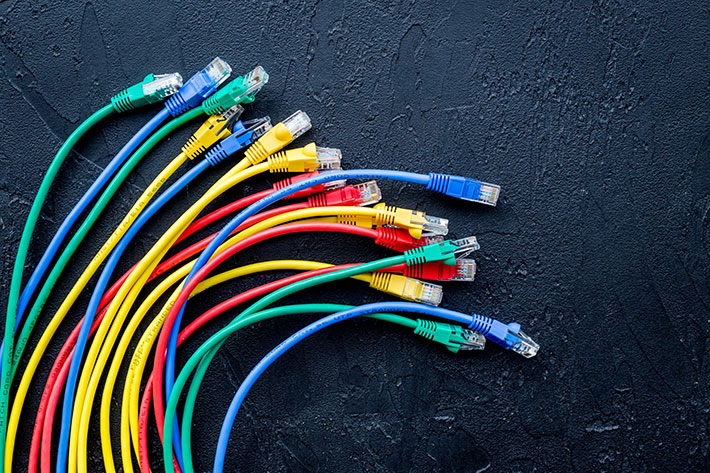
Ethernet cables comprise four pairs of twisted copper wires, with some categories of cable shielded against electromagnetic interference (EMI). The wires carry signals, while the coating helps maintain signal integrity, typically for up to 100 meters. They’re a cost-effective option perfect for small business and residential applications. However, they can struggle in high-EMI environments, especially unshielded cables.
Fiber optic communication is an alternative system to ethernet cables and can be used with them in a hybrid system. Fiber optic cables use fibers comprised of plastic or glass to transmit data as light.
These signals are significantly more stable and are not susceptible to EMI, allowing for fast, flawless transmission over immense distances. However, the delicate nature of the technology offsets these benefits. Installation costs for fiber optics are higher, and they are more likely to become damaged from wear and tear due to their construction.
Ethernet cables are primarily used for networking within buildings. Their durable nature makes them perfect for high-traffic areas or when connecting and disconnecting cables is important. Fiber optics, on the other hand, are ideal for high-capacity backbones and large commercial settings.
Cabling Overview:
Fiber Optic Cables
● Use plastic or glass fibers
● Transmit data via light
● 100Gbps speeds and beyond
● High fidelity over long distances
● Immune to EMI
● High volume
Ethernet Cables
● Use four braided copper wires
● Some categories are capable of up to 10Gbps
● Resistant to physical stress
● Data volume perfect for home or small businesses
● Some categories shielded against EMI
The above information reveals that discussing whether ethernet or fiber optic is superior is unproductive. Each cable type is suited to different applications depending on the project’s needs and budgetary concerns.
Commercial Applications:
Fiber optic cabling is important in industries requiring reliable high-speed data transmission. The communications industry uses it to provide the highest-speed options for business and residential users alike. Medical establishments require instant information transformation free from errors through areas that may have high EMI ratings. Universities often use it as the backbone of their network to ensure they can handle high data volumes.
Ethernet cables are used in commercial applications where EMI concerns are minimal and high-volume transfers aren’t standard. Office spaces, retail locations, and other small businesses get suitable transfer speeds without the costly investment in fiber optics.
Residential Applications
Fiber optic cables have been increasingly used in residential settings due to increasing consumer demand for bandwidth and speed. It is predominantly used in new construction to ensure these buildings have the superior speed and reliability needed for gaming, streaming, and home automation.
While fiber optic cables are rising, ethernet cables remain the dominant cabling choice in residential applications. Their speed and reliability make them perfect for streaming, home offices, and general internet browsing. More importantly, their low-cost point makes them accessible to more consumers.
Consult With Data Cabling Experts for Lasting Effective Results
Home systems are the lifeline that keeps your family connected, creating important bonding moments from gaming, music, and streaming movies. Commercial systems will impact how well your business performs and keeps up with changing technology. These facts mean designing a cable network is an investment in the future of your home or business and should be done with expert guidance.
Contact our knowledgeable and friendly sales staff at Onsite Wire & Cable for assistance with all your low voltage wire and cable needs. As premiere suppliers of low voltage cable products, our fully stocked warehouses in both Michigan and Maryland ensure a timely and secure start to a digital future with all the right products and services.
Speak to an expert anytime and see why businesses throughout the East-Coast and Mid-West partner with us for wire & cable products and services, cable assembly, telecommunications and more!